
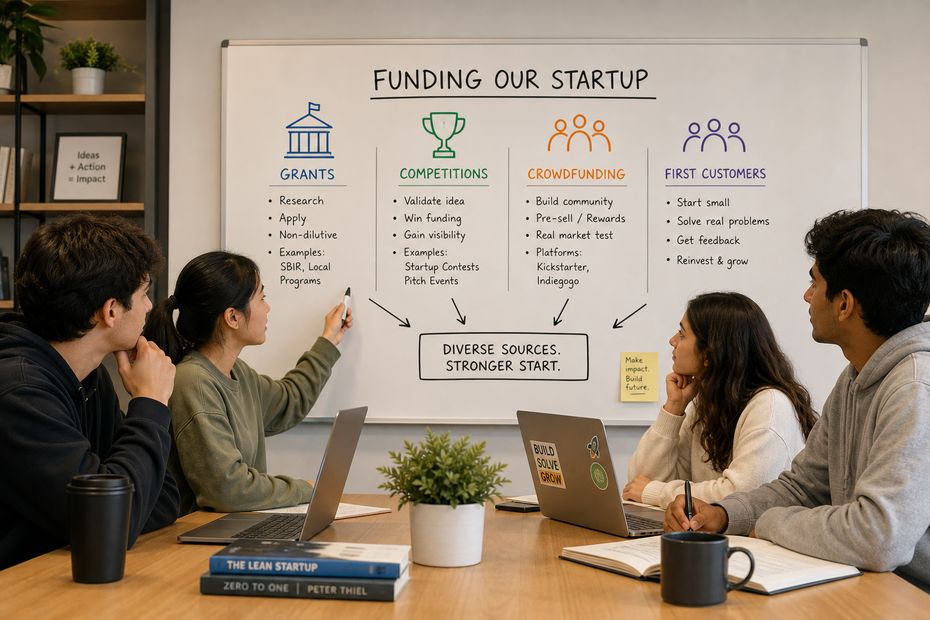
Student startup funding usually begins with non-dilutive money you can access without a credit score, investor network, or early equity deal. Your strongest route is to validate the idea, use university resources, and pursue funding that matches your current proof of demand.
You don’t need to begin with venture capital or a bank loan. You can build from smaller, more accessible sources, then use each result to qualify for larger opportunities. This guide shows you how to choose, sequence, and combine those sources without letting applications consume your academic schedule.
Why Most Startup Funding Advice Does Not Fit Student Founders
Traditional startup advice often assumes you already have industry contacts, personal savings, established credit, and enough time to attend investor meetings. As a student, you may have none of those advantages. Classes, exams, part-time work, and limited business history change which funding options make sense. A conventional loan or investor campaign can create unnecessary pressure before you have proven that customers want your product.
Non-dilutive funding gives you another route. Grants, competition prizes, crowdfunding proceeds, and customer revenue can help you build without immediately surrendering ownership. These sources still require work, but they often reward evidence, preparation, and a strong explanation of the problem you solve rather than personal wealth or collateral.
Your student status can also create access. Universities may offer innovation funds, incubators, faculty guidance, laboratory access, pitch events, and introductions to alumni. The smartest starting point is often the entrepreneurship office already operating on your campus, not an investor you found through a cold email.
Start With Proof Before You Start Applying
Funding applications become stronger when you can show that real people care about the problem. Before applying, speak with potential users, document recurring needs, and test a basic version of your solution. You don’t need a finished product. You need evidence that the idea addresses a specific problem for an identifiable customer.
Choose a simple validation goal that you can measure. That may be ten customer interviews, several letters of interest, a paid pilot, a working prototype, or a small group of active users. Record what people say, what they currently use, what the problem costs them, and whether they will pay for a better option. Judges and grant reviewers usually find verified demand more persuasive than broad market claims.
This early work also tells you which type of student startup funding fits. A research-based product may suit an innovation grant, a social venture may fit a student competition, and a consumer product may work well through rewards-based crowdfunding. A service business could generate revenue faster by selling a limited pilot directly to its first customer.
University And Government Grants Students Can Access
University innovation grants are often the most accessible form of equity-free capital for student founders. Search your school’s entrepreneurship center, business school, engineering department, research office, incubator, and alumni programs. Some funds support prototypes, customer research, software development, testing, or travel connected to a venture. Award sizes and eligibility requirements differ, so read the payment and spending rules before applying.
The Massachusetts Institute of Technology (MIT) Sandbox Innovation Fund Program provides equity-free seed funding of up to $25,000 to eligible student-led teams. Programs like this demonstrate why your campus search should go beyond the main financial aid office. Department-level funds, university venture programs, and donor-backed microgrants may use separate application systems. Ask an entrepreneurship adviser which funds accept applications from individual students, informal teams, and registered companies.
The National Science Foundation (NSF) Innovation Corps, commonly called NSF I-Corps, can provide up to $50,000 to eligible university-based teams testing commercial potential through customer discovery. Federal grant databases also list many programs, but most federal grants are not designed to provide general startup cash to ordinary for-profit businesses. Use Grants.gov as a targeted research tool, not as your only funding plan. Focus your search on programs connected to research, technical development, education, regional economic development, or a defined public need.
Student Pitch Competitions That Write Real Checks
Pitch competitions can provide cash, feedback, visibility, and useful introductions without requiring you to sell equity. The strongest competitions publish clear eligibility rules, judging standards, deadlines, prize terms, and organizer information. Avoid events that charge large entry fees without explaining who judges the applicants or how prizes are paid. A reputable competition should make its process easy to review.
The Hult Prize is a global student social-enterprise competition with a $1 million first prize and participation opportunities for students from colleges and universities. The Rice Business Plan Competition has offered a prize pool of more than $1 million in cash and investment. The MIT $100K Entrepreneurship Competition awards more than $100,000 in prizes annually to student teams. These programs are selective, but they show that student competitions can offer more than certificates and networking sessions.
Your pitch should connect four points: the customer’s problem, your proposed solution, evidence of demand, and the work the funding will support. Avoid spending most of your presentation on industry size or distant growth plans. Judges need to understand what you have already tested and what the award would help you accomplish. A precise spending plan, tied to milestones, makes your request easier to evaluate.
How To Choose The Right Competition
Competition fit matters more than the size of the headline prize. Review enrollment requirements, age limits, geographic rules, venture stage, industry restrictions, team composition, and intellectual property terms. Some programs require full-time enrollment, university affiliation, or a team member from a particular institution. Others focus on social ventures, scientific research, consumer products, or businesses already generating revenue.
The Thiel Fellowship offers a $100,000 grant to people age 22 or younger who plan to build rather than continue attending college. That condition makes it different from a standard campus competition. If you’re enrolled and intend to remain enrolled, compare its participation requirements with your academic plans before investing time in an application. Large awards are only useful when their terms fit your goals.
Create a reusable application folder to reduce repetitive work. Include a short venture summary, team biographies, customer evidence, financial assumptions, product images, a pitch deck, and a basic use-of-funds plan. Adapt those materials to each program rather than starting from scratch. This saves time and keeps your claims consistent across applications.
Crowdfunding As A Student: What Works And What Fails
Crowdfunding works best when you can present a visible product, creative project, or clearly defined customer outcome. Platforms including Kickstarter and Indiegogo let you collect financial support from many backers, often in exchange for rewards or early product access. A campaign can validate demand and produce working capital. It also makes your idea public and requires sustained promotion.
Do not treat the platform as the audience. Successful preparation usually begins before launch with interested customers, email subscribers, campus groups, alumni contacts, community partners, and people who have tested the idea. Build a list of potential supporters, show them the offer, and ask what would make them back it. Early commitments can help the campaign gain momentum once it becomes public.
Your reward design needs accurate pricing. Include production, packaging, platform charges, shipping, replacement orders, and fulfillment time when setting contribution levels. A campaign that raises money but underprices delivery can leave you with more obligations than cash. Use a smaller funding target tied to a defined milestone rather than a vague request to help launch the company.
First Customers And Pre-Sales Can Fund Your Launch
Your first paying customers can provide the most useful form of non-dilutive funding because their payments also prove demand. Revenue tells you whether customers value the solution enough to spend money, not merely praise the idea. It can fund software, materials, testing, or a small production run. It also strengthens later applications by replacing assumptions with purchasing evidence.
Start with a limited offer that you can deliver reliably. You could sell a pilot to a campus department, provide a small batch to a student organization, offer a paid trial to a local business, or accept pre-orders for a defined product. State what the customer receives, when delivery occurs, and what happens if the project cannot meet its commitment. Keep the scope narrow enough to protect your class schedule and product quality.
Customer conversations should focus on current behavior. Ask how the person handles the problem today, how often it occurs, who approves purchases, and what an acceptable result looks like. When interest is strong, request a concrete commitment: a deposit, paid pilot, pre-order, or signed letter of intent. A polite compliment is encouraging, but a transaction gives you much better evidence.
How To Combine Funding Streams Without Burning Out
You do not need to pursue every funding source at once. Sequence the work so that one result strengthens the next application. Begin with customer discovery and a small university grant, use that money to build a prototype, then enter competitions with evidence from testing. Crowdfunding or pre-sales can follow when you know what customers want and how much delivery will cost.
Use a funding calendar with deadlines, eligibility requirements, decision dates, award terms, and required materials. Group applications that need similar documents so you can prepare them together. Set a weekly time limit for funding work and protect the hours needed to build, sell, and study. Winning money will not help if the application process stops the venture from making progress.
Compare opportunities by more than their award amounts. Review the probability of qualifying, time required, payment schedule, ownership terms, publicity requirements, and restrictions on spending. An equity-free $5,000 campus grant may be more useful than an investor program that offers more money but asks for ownership before you have established a fair valuation. Y Combinator’s standard investment provides $500,000 to accepted startups, including eligible student teams, but it is an equity investment rather than a grant.
Protect Your Eligibility, Money, And University Work
Read the rules before accepting funding. Some organizers can pay individuals, but others require a Limited Liability Company (LLC), tax documentation, or a business bank account. Do not register a company solely because you assume every grant requires one. Confirm the payment conditions with the program first, then choose a business structure that fits your operations.
Prize money, grant payments, crowdfunding proceeds, and business revenue can raise tax or financial aid questions. Keep records of every payment and expense, and ask your school’s financial aid office how an award could affect your package. A qualified tax professional can explain how a payment should be reported based on its terms and your circumstances. International students should also speak with their designated university office and a qualified immigration professional before operating a business or accepting compensation.
Review your university’s intellectual property (IP) policy if you use school laboratories, paid faculty time, sponsored research, or university-owned equipment. Ownership rules can differ according to how the work was created and which resources supported it. Speak with your technology transfer or entrepreneurship office before filing an application, disclosing technical details publicly, or promising ownership to another party. This review can prevent confusion during competitions and future fundraising.
How Can Students Fund A Startup Without Investors?
- Apply for university grants
- Enter reputable student pitch competitions
- Use crowdfunding to test demand
- Sell pre-orders or paid pilots
- Join a student incubator
Build Proof Before You Chase Bigger Checks
The best student startup funding plan begins with proof, not the largest available award. Use campus resources to test the idea, target grants and competitions that fit your stage, and approach crowdfunding only after building an audience. Paid pilots, pre-orders, and early sales can give you cash plus evidence that strengthens every later application. Track the conditions attached to each funding source, especially ownership, taxes, university policies, and payment eligibility. When you build one result on top of another, you can finance meaningful progress without surrendering equity before you understand what your company is worth.
References
- Thiel Fellowship
- Hult Prize
- MIT Sandbox Innovation Fund Program
- Rice Business Plan Competition
- MIT $100K Entrepreneurship Competition
- National Science Foundation I-Corps
- Y Combinator Standard Deal
- Grants.gov
- Kickstarter
- Indiegogo
- SCORE
- Association of University Technology Managers.

Yitz Stern is a New York–based entrepreneur and business consultant with 20+ years of experience in alternative funding and real estate. A former CEO of Fundry and managing director at Tiger Financial Technologies, he now advises mid- to large, non-public companies on capital strategy and scalable growth while investing in multifamily real estate